

Let’s say your Burleigh café has been undergoing a fitout for three days. The builder is removing sheeting from the rear wall, the old countertops are in the skip, and then he stops talking. He sets his tools aside and refuses to touch the grey board with a small, dimpled pattern behind the cladding until someone explains what it is.
Many entrepreneurs are aware of that time. The work was proceeding according to plan an hour ago, and now you’re wondering what will happen next as the crew sits on the ute and drinks coffee.
This is how it normally goes.
Work Stops, and the Area Gets Sealed Off
First, cease working close to the questionable stuff. It’s not your builder’s fault. If there is a possibility that asbestos could be disturbed, that portion of the work must wait until it has been inspected.
To keep employees, clients, and other tradespeople out, the area is taped or walled off. A minor issue in one area might become fibres throughout the facility if you allow someone to sweep it up or run the shop vacuum over it.
Losing a few days is preferable to contaminating the entire property, even though it hurts to pay a staff by the day.
Someone Has to Confirm What It Is
You can’t tell asbestos just by looking at it, so the next step is getting a licensed assessor out to take samples. Those go off to a NATA accredited laboratory, and when the results come back, you’ll know whether it’s asbestos, what type it is, and whether it’s bonded or friable.
That last detail changes a lot. Bonded asbestos, like cement sheeting, can be removed by someone holding a Class B licence. Friable asbestos is the loose, crumbly kind, and it needs a Class A licence and much stricter controls, which usually means more time and money.
If the building went up before 2004, use the waiting time to find your asbestos register. Sometimes the material is already on it. Other times, the find is a sign the register needs updating.
Your Renovation Plan Gets Reworked
Once you’ve got results, the plan has to shift, and how far it shifts depends on where the asbestos is and how much of it there is.
A single wall of bonded sheeting might only push things back a few days. If it turns out to be in the ceilings, wrapped around old pipes, and under the floor tiles right across the site, you’re looking at a much bigger rethink.
This is when your builder and your removalist need to talk. Work out together which areas can carry on safely, which have to wait, and what order the trades should come back in. Good commercial asbestos removal teams have dealt with this plenty of times, and they can help you stage the work so any part of the business that can keep trading does.
Licensed Removal Takes Place
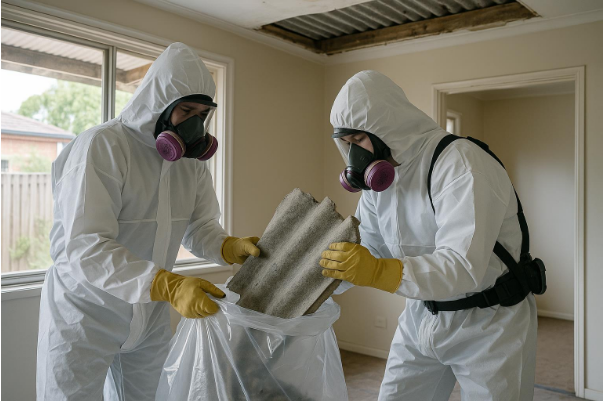
If the asbestos has to come out, a licensed removalist takes over that section of the site. Before licensed removal starts, they’re required to notify Workplace Health and Safety Queensland. Then the containment, signage, and barriers go up, and the crew gets into proper protective gear.
Some jobs also have air monitoring running during the removal, which checks that fibres aren’t getting out. The waste is wrapped, labelled, and taken to a facility that’s allowed to accept it.
Because so many shops, offices, and warehouses on the coast were built while asbestos was still in use, asbestos removal Gold Coast contractors come across mid renovation finds pretty regularly. Ask for a written quote that lists removal, disposal, air monitoring, and clearance on separate lines.
A Clearance Inspection Gives the All Clear
When the removal’s done, the area has to be checked before anyone goes back to work in it. A clearance inspection confirms the job is finished and the space is safe to use.
Then the builders, sparkies, and plumbers can pick up where they left off. Keep the paperwork and update your asbestos register and management plan so they reflect what’s been taken out.
What It Means for Your Budget and Timeline
Finding asbestos partway through a project usually adds both cost and time.
What you can influence is how much. Owners who act quickly, get testing done straight away, and book licensed removal early lose far less time than the ones who hold off or try to work around it.
And if you haven’t started yet, the simplest fix is to test before anything gets pulled apart. Booking commercial asbestos removal before the fit out begins makes it much less likely you’ll end up like that café owner in Burleigh.
How to Avoid the Surprise Next Time
For premises built or renovated before 2004, a few habits go a long way. Keep your asbestos register up to date, review the management plan at least every five years, and have anything that might be disturbed checked before a renovation, a demolition, or even a bigger maintenance job.
It’s also smart to choose a removalist before you need one. Look for the right licence class, experience on commercial sites, and a crew that’s happy to work around your trading hours. If you’re on the coast, line up an asbestos removal Gold Coast team early, so you’re not ringing around in a panic when your builder downs tools.
Frequently Asked Questions
Do I have to stop work if asbestos is found?
Yes. Any work that could disturb the material should stop, and the area should be closed off until it’s been assessed.
Who can remove asbestos from a business premises?
A licensed removalist. For commercial asbestos removal, bonded material needs a Class B licence, and friable material needs Class A.
Can the rest of my business keep trading?
Often, yes. A good asbestos removal Gold Coast team can usually contain the work so the unaffected areas stay open.